
Table of Contents
- What does “registered psychologist” mean?
- Pathway 1: Higher Degree (6+0)
- Pathway 2: 5+1 Internship
- FAQ
What ‘Registered Psychologist’ means…and what it doesn’t
Ask any psychology student what the most common question they get is. 9 out of 10 times, it’s something along the lines of: so do you want to become a psychologist? Followed shortly by a sympathetic, “So you have to do a Master’s degree, don’t you? That’s a lot of studying…”
It’s a common misconception that there is only one way to registration. Yes, the Higher Education pathway is the most common and straightforward route to registration. However, as the saying goes, ‘All Roads Lead to Rome’, and there are other ways to get to the same destination. In Australia, becoming a registered psychologist requires 6 years of accredited education before applying to register with the Australian Board of Psychology.
The two current pathways to General Registration in Australia (2026) are:
- Higher Education Pathway
- 5+1 Internship Pathway
IMPORTANT NOTE: “Registered Psychologist” vs “Clinical Psychologist” (Australia)
Registered psychologist (General Registration) = your licence to practise as a psychologist in Australia.
This is what the 5+1 and Higher Degree (6+0) pathways lead to.
Clinical psychologist = a specialist endorsement after general registration.
You are registered first, then you can complete extra accredited training to become clinically endorsed.
This article is about pathways to General Registration*
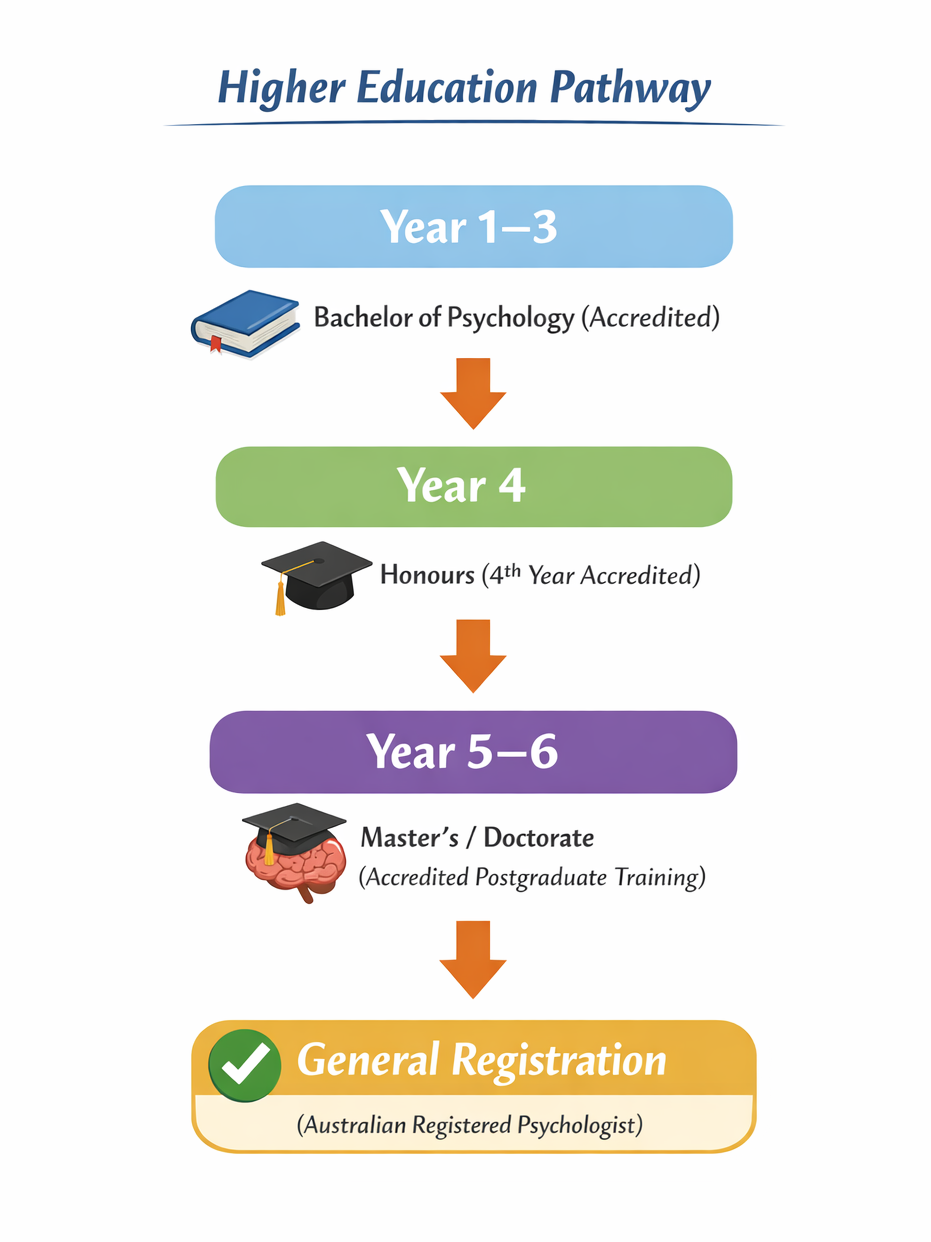
1. Higher Education Pathway
Best for:
- People looking for a structured pathway that leads naturally to endorsement
- Built-in placements
- Those interested in completing postgraduate study
- Those interested in research/academia
The steps:
Step 1: 4-year accredited psychology sequence
Step 2: 2-year accredited postgraduate degree (Master’s) OR Doctorate
Step 3: Apply for general registration
Timeline example:
| Pros | Cons |
|---|---|
| Many undergraduate psychology degrees have built-in placements that offer work experience | Entry to Honours and Master’s programs is highly competitive |
| Builds the skills needed for research | Substantial financial and time investment |
| Don’t need to sit the National Psychology Exam to apply for General Registration |
For more info:
https://www.psychologyboard.gov.au/Registration/Provisional/Higher-Degree.aspx
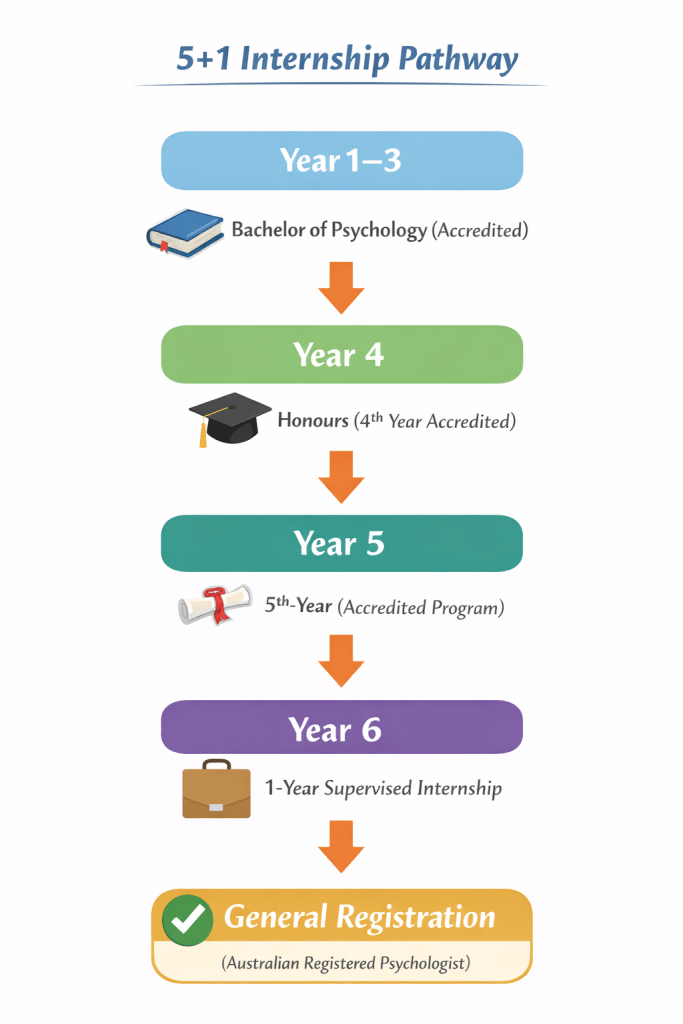
2. 5+1 Internship Pathway
Best for:
- Those looking for an alternate pathway to the Higher Education route
- More practical experience before becoming a clinical psychologist
The steps:
Step 1: 4-year accredited psychology sequence
Step 2: Accredited 5th-year program
Step 3: 1-year supervised internship
Step 4: Apply for general registration
Timeline example:
| Pros | Cons |
|---|---|
| Faster pathway to general registration | Longer pathway for Clinical Endorsement |
| Flexibility for those unsure of postgraduate studies | Must sit the National Psychology Exam |
| Allows for more “real world” experience before specialising | Internships can be stressful to organise |
National Psychology Exam:
- Required to apply for General Registration
- Taken during your 6th year
- For more info: https://www.psychologyboard.gov.au/Registration/National-psychology-exam.aspx
For more info:
https://www.psychologyboard.gov.au/Registration/Provisional/5-1-Internship-Program.aspx
What about the old 4+2 pathway?
You might have heard about the 4+2 pathway. This route included 4 years of an accredited undergraduate degree followed by 2 years of an internship. However, the 4+2 internship pathway is closed to new applicants as of 30 June 2022.
For more info:
https://www.psychologyboard.gov.au/Registration/Provisional/Retirement-of-4-2-internship.aspx
FAQ
1) Can I become a psychologist without doing a Master’s?
Yes, the 5+1 pathway can lead to general registration without a 2-year specialist Master’s. However to become a Clinical Psychologist you will need additional postgraduate training specifically for Clinical psychology (Masters or Doctorate).
2) What if I don’t get into Honours (4th year) straight away?
Getting into Honours is competitive and intimidating for everyone. If you don’t quite hit the marks, don’t worry you have a few options. You could apply for other universities or complete an APAC accredited 4th year bridging program or diploma.
3) Which pathway is more competitive to get into?
Generally, postgraduate Master’s programs (especially clinical) are highly competitive, while the 5+1 path can feel more accessible depending on your uni/state.
There you have it!
If you’ve just started your psychology degree or you’re considering becoming a registered psychologist the important thing to remember is: you have options. So the next time you’re stressing over a report or steeping in existential dread, try to look at the bigger picture. Happy studying!

Read Next:
 The Psych Diaries
Leave a comment