Summary
Difficulty: ★★☆☆☆
Covers: nature/nurture/culture, motor development differences, major theories of development, prenatal stages & teratogens, Piaget’s stages, Vygotsky & information processing, gender development & stereotypes, theories of gender, moral development
Quizlet flashcards:https://quizlet.com/au/1121009834/psyu1101-week-2-developmental-psychology-1-flash-cards/?i=6xlcf8&x=1jqt
What is Developmental Psychology?
Developmental psychology studies systematic changes and continuities that occur from birth to death. These changes arise from physical maturation, cognitive growth, and social experiences.
Nature, Nurture & Culture in Development
Universal Genetically Determined Capacities
Some developmental processes are biologically primed, such as:
- Language acquisition
- Motor development
Environmental Influences
Children’s traits are shaped by their surroundings. Different environments emphasise different abilities depending on survival or cultural needs.
Parenting & Cultural Context
Parenting styles and cultural values interact with biology to shape temperament, skills, and developmental timelines.
Examples of Cultural Differences in Motor Development
- Annette Hamilton’s study (Indigenous Australian infants):
Infants carried on caregivers’ backs with strong sitting support reached motor milestones earlier. - SIDS prone-positioning effect:
After prone sleeping was linked to SIDS, parents avoided tummy-time; many children showed delayed motor skills like head lifting and arm propping.
Major Theoretical Approaches
Psychoanalytic Theory (Freud)
Behaviour arises from interactions between the conscious and unconscious mind (id, ego, superego).
Cognitive Developmental Theory (Piaget)
Cognitive abilities evolve through biological maturation and environmental interaction. Development occurs through fixed stages.
Social Cognitive Theory (Bandura)
Development is shaped by personal experiences, observing others, and environmental influences.
Ethological Theory (Bowlby & Ainsworth)
Focuses on evolutionary roots of behaviour; attachment systems develop to ensure survival.
Psychosocial Theory (Erikson)
Development involves changes in self-concept, identity, and social roles across the lifespan.
Biological Stages of Prenatal Development
- Zygote
- Blastocyst
- Embryonic period — period of greatest sensitivity
- Foetal period
Sensitive Periods & Teratogens
- Sensitive periods: Times when the body is highly susceptible to environmental disruption.
- Teratogens: Environmental agents that impair prenatal development.
- Embryonic period is the most vulnerable.
- The first 3 years are crucial for brain development, myelination, and white-matter growth. Early trauma can have long-term impacts.
Piaget’s Theory of Cognitive Development
Piaget proposed that children are active learners and think qualitatively differently from adults. Development involves balancing new and existing knowledge through:
- Assimilation: Fitting new information into existing schemas
- Accommodation: Modifying schemas for new information
- Equilibration: Maintaining cognitive balance
Piaget’s 4 Stages
1. Sensorimotor (0–2):
Object permanence; understanding the world through sensory experiences
2. Pre-operational (2–7):
Symbolic thought, egocentrism, lack of conservation
3. Concrete operations (7–11):
Logical thinking with concrete objects; mental operations
4. Formal operations (12+):
Abstract and hypothetical thinking
Other Cognitive Theories
Vygotsky’s Sociocultural Theory
- Emphasises social interaction, cultural tools, and scaffolding in learning.
Information Processing Approach
- Focuses on neural maturation and specific cognitive functions such as memory, attention, and language.
Gender Development
Modern developmental psychology recognises a spectrum of gender identities and acknowledges both biological and environmental influences.
Gender Stereotypes & Socialisation
Expectations for how children “should” behave are reinforced through:
- Parenting practices
- Educational systems
- Media
- Toy marketing (pink vs blue)
Research Examples
Girl vs Boy Toys Experiment
- Children were dressed as the opposite gender and assigned new names.
- Adults unknowingly treated them based on gender stereotypes.
- Encouraging or restricting certain toys can actually influence brain development (e.g., spatial awareness).
Jack-in-the-Box Experiment
- Same startled reaction was labelled fear for girls but anger for boys.
- Shows how adults interpret children’s emotions through gendered lenses.
Early Gender Identity
- By age 2, children recognise themselves as a boy or girl.
- Gender understanding becomes more rigid during early childhood due to intense socialisation.
Adolescence
Adolescents form more nuanced gender identities influenced by:
- Puberty
- Increased social mixing
- Social media
- Expanding worldviews
Stereotypes vs Research Findings
| Stereotype | Research Result |
|---|---|
| Males are more aggressive | Males → physical; females → relational aggression |
| Females are more social | Higher empathy/social connection, but culturally shaped |
| Males are more analytical | Differences are minimal |
| Males are more rational | No evidence |
| Males have greater spatial/maths ability | Slight average differences; largely training/socialisation |
Theories of Gender Development
Psychoanalytic (Freud)
Gender identity stems from resolving conflicts in the phallic stage (Oedipus/Electra complexes).
Modern psychology views this as outdated.
Biological Basis
- Chromosomes (XX, XY)
- Hormones influence secondary sex characteristics
- Evolutionary explanations based on maximising reproductive success
- Modern research highlights:
- Testosterone is socially modulated
- Biological determinism is limited
- Gender is fluid, not binary
Cognitive Developmental Theory (Piaget & Kohlberg)
Stages of gender understanding:
- Gender identity (2–3): “I am a boy/girl.”
- Gender stability (4–5): Gender is stable over time.
- Gender consistency (6–7): Gender stays constant across situations.
Kohlberg emphasised the importance of biological recognition (genitalia) and cognitive maturation (conservation).
Gender Schema Theory (Sandra Bem)
Children build schemas about gender from cultural norms and then actively seek experiences that confirm them.
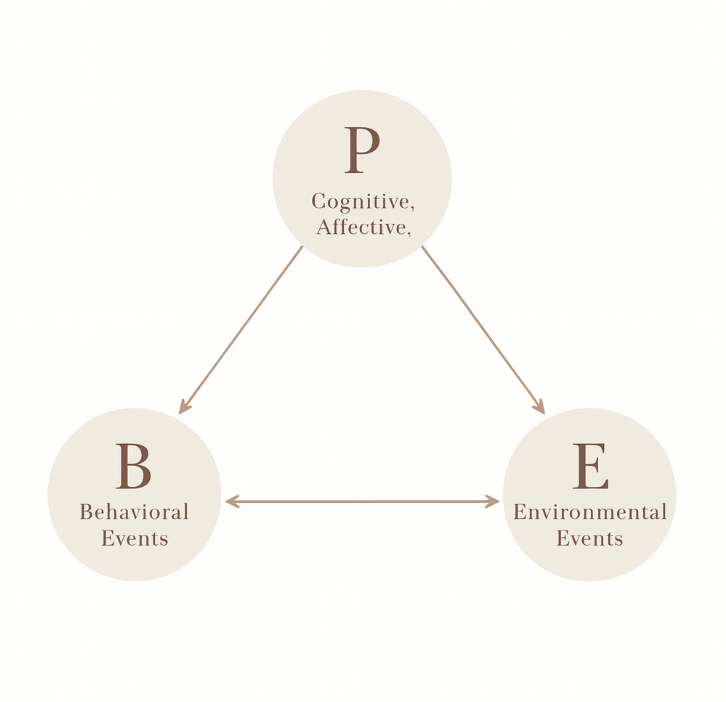
Social Cognitive Theory (Bandura)
Gendered behaviours develop through:
- Attention
- Retention
- Reproduction
- Motivation
This occurs within triadic reciprocal determinism: behaviour, personal characteristics, and environment all influence each other.
Moral Development
Piaget
- Morality of constraint: Young children judge right/wrong based on consequences.
- Morality of cooperation: Older children consider intentions.
Kohlberg’s Stages
- Pre-conventional: Avoid punishment, seek rewards
- Conventional: Follow rules, desire social approval
- Post-conventional: Personal ethics and justice
Moral Disengagement
The discrepancy between moral reasoning and moral behaviour.
People justify harmful behaviour through:
- Excusing (justifying)
- Obscuring (minimising)
- Vilifying the victim
 The Psych Diaries
Leave a comment